

James Gorman and Hiroshi Mikitani are two influential business leaders known for their different approaches to business growth and leadership. James Gorman is recognized for transforming Morgan Stanley into a stronger financial institution, while Hiroshi Mikitani is famous for founding Rakuten and building a global digital business. Their careers offer valuable lessons about strategy, innovation, and long-term success.
Many readers want to understand whether these executives share a direct professional connection or are simply compared because of their achievements. Although a confirmed business partnership between them has not been established in the publicly available information reviewed, their leadership styles provide an interesting comparison.
Gorman focused on wealth management expansion and institutional transformation, while Mikitani pursued entrepreneurial leadership and digital ecosystem growth. By exploring their backgrounds, achievements, and business strategies, readers can better understand their individual contributions.
This article examines their careers, corporate leadership models, and major differences to clarify their real connection and explain why their stories matter.
Who Are James Gorman and Hiroshi Mikitani?
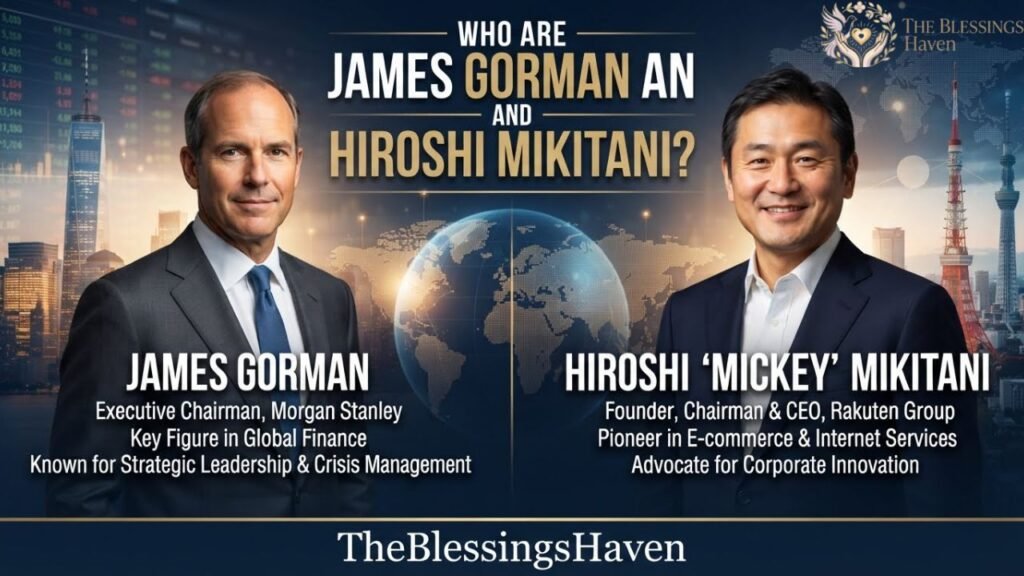
James Gorman is an Australian-born American business executive known for his leadership at Morgan Stanley. He served as the company’s chief executive officer from 2010 to 2023 and as chairman from 2012 to 2023. During his tenure, he helped shift the investment bank toward a business model with a stronger focus on wealth and investment management.
Gorman’s career included experience in consulting and financial services before he joined Morgan Stanley in 2006. His leadership became associated with long-term planning, business restructuring, and the expansion of financial advisory services.
Hiroshi Mikitani is a Japanese entrepreneur and the founder of Rakuten Group. He established Rakuten in 1997, initially focusing on online shopping. Over time, the company expanded into financial services, mobile telecommunications, digital content, travel, and other technology-based businesses.
Mikitani is known for his entrepreneurial approach and willingness to enter competitive markets. His strategy has involved connecting different services through a broad digital ecosystem.
Although their professional backgrounds differ, both executives demonstrate how leadership decisions can influence the direction of large organizations. Gorman focused on strengthening an established financial institution, while Mikitani built a diversified business from the ground up.
What Is the Connection Between James Gorman and Hiroshi Mikitani?

The most important point is that a direct professional connection between James Gorman and Hiroshi Mikitani has not been firmly established in the publicly available information considered here. There is insufficient evidence to describe them as business partners, close associates, or participants in a confirmed joint venture.
Their names can nevertheless be discussed together because they represent different approaches to corporate leadership and expansion.
Gorman’s work at Morgan Stanley involved improving an established financial institution, developing wealth management, and balancing growth with financial stability. Mikitani’s work at Rakuten involved creating new services, entering different markets, and building a connected business ecosystem.
Their careers also intersect with broader themes in global business. Both have operated in highly competitive industries, managed large organizations, and made decisions that required long-term thinking.
However, these similarities do not prove a personal relationship or a shared business venture. A confirmed connection would require reliable evidence, such as an official announcement, documented partnership, corporate filing, or credible report identifying a specific interaction.
For readers researching this topic, the distinction matters. Comparing two executives can provide useful insights even when no direct relationship between them has been demonstrated.
James Gorman’s Career and Morgan Stanley Transformation
James Gorman joined Morgan Stanley in 2006 after working in consulting and financial services. He held senior management responsibilities before becoming co-president and eventually CEO in 2010.
His appointment came after a difficult period for the global financial industry. The 2008 financial crisis had exposed weaknesses across banking and investment markets. Financial institutions faced pressure to strengthen their balance sheets, manage risk, and restore investor confidence.
Gorman’s leadership emphasized a more balanced business model. Rather than depending heavily on trading and investment banking, Morgan Stanley expanded its wealth and investment management operations.
This strategic direction helped the company develop more recurring revenue streams through financial advice, asset management, and services for wealthy individuals and institutions.
Gorman also oversaw important acquisitions that strengthened the firm’s capabilities. Morgan Stanley’s acquisition of Smith Barney and its later integration into Morgan Stanley Wealth Management helped expand its financial adviser network and client assets.
The acquisition of E*TRADE, completed in 2020, strengthened the firm’s position in digital brokerage and workplace stock plan services. The 2021 acquisition of Eaton Vance further expanded its asset management business.
These moves illustrate Gorman’s approach: use acquisitions and internal development to build a more diversified financial institution.
Expansion of Wealth Management
Wealth management became one of the most important parts of Morgan Stanley’s strategy under Gorman.
Traditional investment banking can generate significant revenue, but its performance often changes with market conditions. Wealth management provides a different business model by serving clients over longer periods through financial planning, investment advice, and portfolio management.
Morgan Stanley expanded its adviser network, digital capabilities, and range of financial products. The company also strengthened its relationships with affluent households, high-net-worth individuals, and institutional clients.
The E*TRADE acquisition added a digital platform that appealed to self-directed investors. It also created opportunities to connect workplace financial services with broader wealth management offerings.
The Eaton Vance acquisition increased Morgan Stanley’s investment management capabilities, including its range of strategies and investment products.
Together, these changes helped Morgan Stanley build a more diversified revenue base. They also reflected Gorman’s belief that wealth and investment management should play a central role in the company’s future.
Gorman’s Succession at Morgan Stanley
Gorman stepped down as Morgan Stanley’s CEO at the end of 2023 after leading the company for approximately 13 years. Ted Pick succeeded him as CEO on January 1, 2024.
Gorman remained chairman during a transition period and later stepped down from that position in 2024. His departure marked the end of a significant chapter in Morgan Stanley’s modern history.
Leadership succession is an important part of corporate governance. A successful transition requires more than naming a replacement. It involves preparing future leaders, maintaining investor confidence, and ensuring that the company’s strategy continues beyond one executive’s tenure.
Gorman’s succession also reflected the importance of continuity at a large financial institution. Morgan Stanley had developed a broader business model during his leadership, and the next CEO inherited the responsibility of maintaining that direction while responding to changing markets.
His legacy is closely associated with the growth of wealth management and the strategic acquisitions that reshaped Morgan Stanley’s operations.
James Gorman’s Role at Disney
James Gorman’s connection to Disney is separate from his work at Morgan Stanley.
In October 2024, The Walt Disney Company announced that Gorman would join its board of directors. Disney subsequently appointed him chairman of its board, effective January 2, 2025.
This appointment placed Gorman in a corporate governance role at one of the world’s best-known entertainment companies. His experience in financial management, strategic planning, executive succession, and board oversight offered a different set of skills from those associated with Disney’s creative and entertainment operations.
As chairman, Gorman’s responsibilities involve board leadership and oversight rather than personally managing Disney’s films, television networks, theme parks, or streaming services.
His experience managing leadership transitions at Morgan Stanley is particularly relevant to board-level succession planning. Large public companies need effective systems for evaluating executives, managing risk, and planning for future leadership.
Gorman’s appointment also illustrates how senior executives can influence organizations beyond the industries in which they built their original reputations.
His role at Disney should not, however, be treated as evidence of a professional relationship with Hiroshi Mikitani. The two matters are separate unless reliable reporting establishes otherwise.
You May Like To Read: Victoria Granucci: 7 Amazing Facts About Her Life
Who Is Hiroshi Mikitani?
Hiroshi Mikitani is a Japanese entrepreneur best known for founding Rakuten Group, one of Japan’s major internet services companies. Born in 1965, he studied at Hitotsubashi University before earning an MBA from Harvard Business School.
Before establishing Rakuten, Mikitani worked in banking at the Industrial Bank of Japan. This experience gave him exposure to finance, business strategy, and corporate management.
In 1997, he launched an online shopping business that became Rakuten Ichiba. At the time, internet shopping was still developing in Japan. Mikitani saw an opportunity to help merchants reach customers through an online marketplace.
Rather than limiting Rakuten to online retail, he gradually expanded the company into several connected industries. These include credit cards, online banking, securities trading, travel booking, digital content, and mobile telecommunications.
Mikitani’s approach is based on the idea that customers can benefit from accessing multiple services within one business ecosystem. Rakuten’s loyalty program, Rakuten Points, supports this strategy by encouraging customers to use more than one service.
As chairman and CEO, Mikitani remains a central figure in the company’s long-term direction. His leadership combines entrepreneurial ambition with a willingness to invest in new markets, even when those investments require substantial time and resources to become profitable.
How Mikitani Built the Rakuten Ecosystem
Rakuten’s growth is one of the clearest examples of how a company can expand beyond its original business. What began as an online shopping marketplace developed into a broad digital ecosystem.
Mikitani’s strategy focuses on creating connections between services. A customer might shop through Rakuten Ichiba, earn loyalty points, use a Rakuten credit card, and later spend those points on another Rakuten service.
This approach can strengthen customer loyalty and encourage repeat purchases.
Several major business areas contribute to the ecosystem:
- E-commerce: Rakuten Ichiba connects online merchants with shoppers and remains a central part of the company’s identity.
- FinTech: Rakuten offers financial services that include credit cards, banking, securities, and payment solutions.
- Mobile telecommunications: Rakuten Mobile competes in Japan’s telecommunications market and requires substantial investment in network infrastructure.
- Digital content: Services such as Rakuten Kobo provide access to digital books and related products.
- Travel and lifestyle: Rakuten has offered online travel booking and other consumer services that complement its marketplace.
- Loyalty programs: Rakuten Points connect eligible services and give customers incentives to remain within the ecosystem.
The main advantage of this model is cross-selling. Someone who already uses one Rakuten service may be more willing to try another. This can help the company strengthen customer relationships without relying entirely on acquiring new customers.
However, diversification also creates challenges. Each business has its own competitors, costs, regulations, and operational demands. Mobile telecommunications, in particular, requires significant infrastructure spending and can put pressure on profitability.
Mikitani’s strategy therefore combines considerable growth opportunities with financial risks. Rakuten’s long-term success depends on converting its broad customer ecosystem into sustainable earnings and cash flow.
Rakuten’s Current Financial Position
Rakuten’s financial position is important when evaluating Mikitani’s leadership. Revenue growth alone does not tell the full story because a diversified company can expand sales while still facing profitability challenges.
According to Rakuten Group’s official full-year 2025 results, published in February 2026, the company reported the following consolidated figures. Source: Rakuten Group’s 2025 financial results.
| Financial measure | FY2024 | FY2025 |
|---|---|---|
| Revenue | ¥2.279 trillion | ¥2.497 trillion |
| Operating profit | ¥52.975 billion | ¥14.382 billion |
| Net loss attributable to owners | ¥162.442 billion | ¥177.886 billion |
Figures are in Japanese yen and reflect Rakuten Group’s consolidated results under IFRS.
These results show a mixed financial picture. Revenue increased by approximately 9.5% in 2025, but operating profit fell significantly. The company also recorded a larger net loss than in the previous year.
The difference between revenue and profit is important. Higher sales can indicate stronger demand, but operating expenses, infrastructure investments, financing costs, and other factors influence how much money remains.
Rakuten’s mobile business has been a particularly important part of its broader investment strategy. Building a competitive telecommunications operation requires substantial capital and takes time to deliver the desired financial returns.
At the same time, e-commerce and financial services provide important foundations for the wider group. The company’s challenge is to strengthen these businesses while improving the financial performance of its more capital-intensive operations.
For investors and business observers, the key questions are whether Rakuten can improve profitability, manage its financing needs, and generate stronger returns from its ecosystem.
These results also show why Mikitani’s leadership model differs from Gorman’s. Gorman emphasized transforming an established financial institution through acquisitions and business diversification. Mikitani continues to manage a founder-led company balancing established revenue sources with ambitious investments.
Mikitani’s Ownership Position
Mikitani’s ownership position is another important part of his leadership story.
According to Rakuten’s official shareholder information as of December 31, 2025, Hiroshi Mikitani held approximately 8.14% of Rakuten Group’s issued shares. The company listed 176,703,400 shares under his name. Source: Rakuten’s shareholder information.
Although this stake is not a majority ownership position, it represents a substantial individual holding in a large publicly traded company.
Ownership and management authority are not the same thing. A founder can retain considerable influence through executive responsibilities, board leadership, strategic experience, and relationships with other shareholders.
Mikitani’s position as chairman and CEO gives him a central role in setting Rakuten’s direction. His founder status also connects his personal business vision with the company’s identity and long-term strategy.
However, his ownership stake should not be confused with complete control of every corporate decision. Rakuten is a publicly traded company with numerous shareholders, and its governance responsibilities extend beyond the founder.
This structure differs from Gorman’s career at Morgan Stanley. Gorman rose through the ranks of an established financial institution and led it as a professional executive. Mikitani founded Rakuten and continues to guide the company he created.
Both models can be effective, but they involve different relationships between leadership, ownership, and corporate accountability.
James Gorman and Hiroshi Mikitani: Two Leadership Models
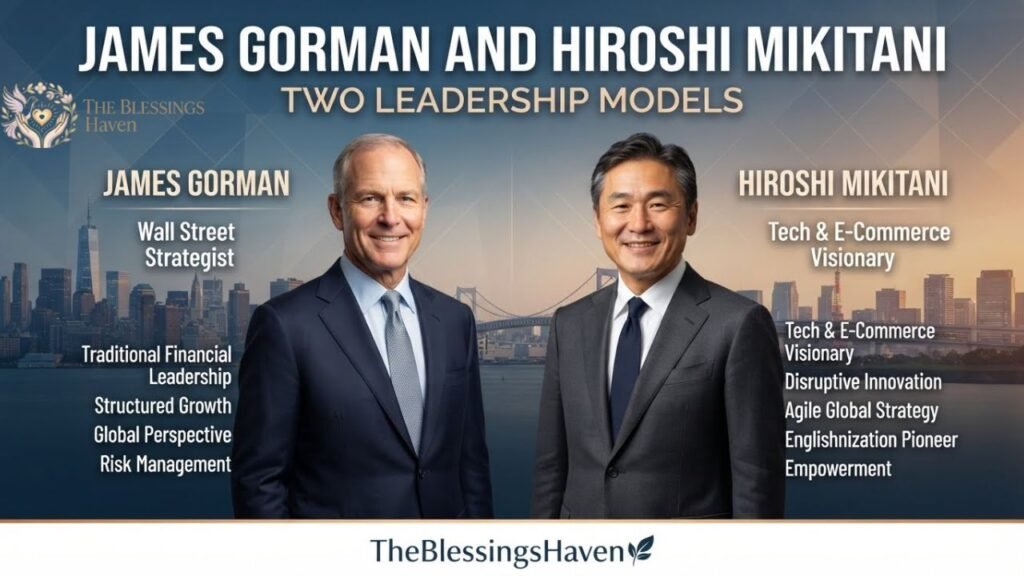
James Gorman and Hiroshi Mikitani offer two distinct examples of leadership in large organizations.
Gorman’s career demonstrates how an executive can reshape an established company. Mikitani’s career shows how a founder can build an organization around a broad business vision and expand it into multiple industries.
Their approaches differ in several important ways.
Gorman: Institutional Transformation
Gorman’s leadership at Morgan Stanley focused on improving the company’s business mix, expanding wealth management, and strengthening its position in financial services.
He inherited an established institution with a global client base, experienced employees, and existing business operations. His challenge was to adapt the company to changing financial markets while maintaining investor and client confidence.
Acquisitions played an important role in this transformation. The expansion of Morgan Stanley Wealth Management, the E*TRADE acquisition, and the addition of Eaton Vance strengthened the company’s position across different parts of the financial industry.
Gorman also demonstrated the importance of leadership succession. His departure from the CEO role followed a planned transition to Ted Pick, allowing Morgan Stanley to maintain continuity.
His model can be described as institutional transformation: improve an established organization by changing its priorities, capabilities, and long-term strategy.
Mikitani: Founder-Led Expansion
Mikitani’s leadership began with a new business rather than an established global corporation.
He identified an opportunity in Japanese e-commerce and developed Rakuten into a much broader collection of digital services. His approach relies on entrepreneurship, experimentation, and entering markets where he believes the company can build a competitive position.
Founder-led businesses can benefit from a clear vision and relatively consistent strategic direction. A founder may also be willing to make long-term investments that take years to produce meaningful returns.
However, this approach carries risks. Expanding into too many industries can stretch resources, increase debt or financing pressure, and make management more complex.
Rakuten’s investment in mobile telecommunications illustrates this balance between ambition and financial discipline.
Mikitani’s leadership model therefore emphasizes building new markets, connecting services, and extending the original business into a wider ecosystem.
What They Have in Common
Despite their different careers, Gorman and Mikitani share several broad leadership characteristics.
First, both understand the importance of long-term strategy. Gorman invested in wealth management and digital brokerage to strengthen Morgan Stanley’s future business mix. Mikitani expanded Rakuten beyond e-commerce to create additional sources of revenue and customer engagement.
Second, both have embraced business diversification. Gorman strengthened several areas within financial services. Mikitani expanded into e-commerce, financial technology, telecommunications, and digital content. Their methods differ, but both recognized the risks of relying too heavily on a single business activity.
Third, both operate in competitive global markets. Financial services and digital technology require constant attention to customer expectations, regulation, innovation, and changing economic conditions.
Fourth, both have influenced organizational culture. Leaders shape how companies allocate resources, respond to challenges, and evaluate opportunities. Their strategic choices influence employees, investors, customers, and business partners.
Finally, both careers show that leadership involves trade-offs. Expansion can create new opportunities, but it can also introduce risk. A successful strategy must balance ambition with financial discipline and operational execution.
These shared characteristics make the two executives useful subjects for comparison. They do not, however, establish that the men have a personal relationship or a direct commercial partnership.
Major Differences Between Gorman and Mikitani
The clearest differences between Gorman and Mikitani concern their professional backgrounds, leadership responsibilities, and approaches to growth.
| Area | James Gorman | Hiroshi Mikitani |
|---|---|---|
| Primary association | Morgan Stanley and Disney | Rakuten Group |
| Career background | Consulting and financial services | Banking and entrepreneurship |
| Leadership path | Professional executive | Founder and CEO |
| Main business environment | Financial services and corporate governance | E-commerce, fintech, telecommunications, and digital services |
| Growth strategy | Acquisitions and institutional transformation | New ventures and ecosystem expansion |
| Key challenge | Maintaining growth, stability, and succession | Balancing expansion with profitability |
| Ownership context | Led an established public financial institution | Founder with a reported 8.14% personal stake in Rakuten at year-end 2025 |
Another important difference is their relationship with the organizations they lead or have led.
Gorman’s influence came largely through executive responsibilities, strategic decisions, and board leadership. He is now chairman of Disney and chairman emeritus of Morgan Stanley.
Mikitani’s influence is closely linked to founding Rakuten and continuing to direct its strategy. His leadership remains associated with the development of the company he created.
Their approaches also involve different measures of success. For Gorman, important measures included Morgan Stanley’s business mix, client relationships, earnings, and institutional strength. For Mikitani, success involves growing the Rakuten ecosystem while making its different business segments financially sustainable.
Neither model is automatically better. The right approach depends on a company’s maturity, industry, competitive position, resources, and strategic goals.
Why the James Gorman and Hiroshi Mikitani Comparison Matters
Comparing James Gorman and Hiroshi Mikitani helps readers understand two different ways of building business value.
Gorman’s experience demonstrates the importance of improving an established company’s operations. His Morgan Stanley strategy involved strengthening wealth management, expanding digital services, and using acquisitions to diversify revenue.
Mikitani’s experience highlights the opportunities and challenges of entrepreneurship. Rakuten grew from an online shopping marketplace into a wide-ranging digital business, illustrating how a founder can develop new revenue sources by connecting related services.
Their careers also offer lessons for business owners and managers.
A company does not always need to enter new industries to grow. Sometimes, improving its core operations and expanding services for existing customers can produce better long-term results.
On the other hand, companies in fast-changing markets may need to experiment with new products and business models. Diversification can create opportunities when it supports a clear strategy and is backed by sufficient resources.
Another lesson concerns financial discipline. Rakuten’s recent results show that revenue growth does not automatically lead to higher operating profit. Businesses must consider costs, capital requirements, and returns when pursuing expansion.
The comparison is also useful for understanding corporate succession. Gorman’s transition at Morgan Stanley demonstrates the importance of preparing future leaders, while Mikitani’s continued leadership raises different questions about founder influence and long-term organizational development.
Ultimately, the value of comparing these executives lies in understanding their decisions, not assuming an undocumented connection between them.
Frequently Asked Questions
Who are these two business leaders?
James Gorman is a senior business executive known for leading Morgan Stanley and serving as chairman of Disney. Hiroshi Mikitani is a Japanese entrepreneur who founded Rakuten Group and continues to serve as its chairman and CEO.
What companies are they associated with?
Gorman is associated with Morgan Stanley, where he served as CEO from 2010 to 2023, and Disney, where he became board chairman in January 2025. Mikitani is associated with Rakuten Group, the Japanese e-commerce and digital services company he founded in 1997.
What is James Gorman known for?
Gorman is known for transforming Morgan Stanley’s business model, expanding wealth management, overseeing major acquisitions, and managing an orderly CEO succession. He is also known for his corporate governance role at Disney.
What is Hiroshi Mikitani known for?
Mikitani is best known for founding Rakuten and expanding it from an online marketplace into a broad ecosystem of e-commerce, financial services, mobile telecommunications, and digital products.
Are they connected professionally?
A direct business partnership or formal professional relationship between Gorman and Mikitani has not been established by the reliable public information reviewed for this article. They can be compared as influential executives, but their shared discussion does not prove that they work together.
Do they have similar leadership backgrounds?
They share experience in strategic decision-making, diversification, and managing complex organizations. However, Gorman developed his career as a professional executive, while Mikitani built Rakuten as an entrepreneur and founder.
Why are these two names mentioned together?
Their names may appear together in business articles and online searches because their careers provide an interesting comparison of leadership styles. Gorman represents institutional transformation, while Mikitani represents founder-led expansion. Readers should look for documented evidence before assuming a direct relationship.
Final Thought
James Gorman and Hiroshi Mikitani demonstrate two different approaches to business leadership. Gorman helped transform Morgan Stanley by strengthening wealth management, expanding digital capabilities, and improving its long-term business mix. Mikitani built Rakuten from an online marketplace into a diversified digital ecosystem that spans several industries.
Their careers share themes of strategic planning, diversification, and adaptation. However, their professional paths, ownership positions, and management responsibilities remain distinct.
The most important takeaway is that a meaningful leadership comparison does not require a confirmed personal or business connection. Studying both executives can help readers understand how companies grow, how leaders manage risk, and why different business models require different strategies.
For entrepreneurs, the lesson is to pursue growth with a clear purpose. For established companies, it is to adapt without losing sight of their core strengths. Both careers also show that long-term success depends on execution, financial discipline, and the ability to respond to changing market conditions.
Although the exact connection suggested by their names remains unconfirmed, their leadership stories offer valuable insights into the modern business world.

Welcome to The Blessings Haven! Rathna is a passionate content creator sharing heartfelt blessings, inspirational quotes, prayers, and meaningful wishes, along with helpful technology articles, digital trends, and online guides.