

Introduction
The name Helonium may sound like the name of a chemical element, but it is not.
Helonium is another name used for the helium hydride ion, HeH⁺, a positively charged molecular ion made from helium and hydrogen. Its systematic name is hydridohelium(1+). ChEBI identifies it as a helium hydride with the formula HHe and a net charge of +1.
What makes Helonium especially interesting is not its size but its history. Scientists first found laboratory evidence for HeH⁺ in 1925, yet it took decades before the ion was unambiguously detected in space. In 2019, astronomers finally observed its characteristic rotational transition in the planetary nebula NGC 7027 using the SOFIA airborne observatory.
Its importance reaches even further back. Models of the early Universe place HeH⁺ near the beginning of molecular chemistry, when neutral helium could react with protons and form one of the first molecular bonds. Later reactions involving the ion helped connect this early chemistry with the formation of molecular hydrogen.
Recent laboratory studies show that Helonium remains scientifically important. A 2025 experiment investigated its low-temperature reaction with deuterium, while a 2026 spectroscopy study measured its fundamental rotational transition with substantially improved precision.
Direct Answer: What Is Helonium?
Helonium is the helium hydride ion, HeH⁺. It is a positively charged molecular ion containing helium and hydrogen, not a chemical element.
The systematic name is hydridohelium(1+), and the ion has a net charge of +1. ChEBI lists its average mass as about 5.011 daltons and assigns it the identifier CHEBI:33688.
In simple terms, Helonium can be understood as helium bonded to a hydrogen nucleus, with the overall species carrying one positive charge. This unusual combination is possible even though neutral helium is well known for being chemically unreactive.
The name can therefore be confusing. Helonium sounds similar to names used for elements, but there is no element named Helonium on the periodic table.
Quick Facts
| Fact | Verified detail |
|---|---|
| Common scientific name | Helium hydride ion |
| Common name | Helonium |
| Formula | HeH⁺ / HHe⁺ |
| Systematic name | Hydridohelium(1+) |
| Net charge | +1 |
| Main atoms | Hydrogen and helium |
| ChEBI ID | CHEBI:33688 |
| Average mass | 5.011 Da |
| First laboratory evidence | 1925 |
| First secure space detection | 2019 |
| Detection site | NGC 7027 |
| Observatory | SOFIA |
| Instrument | GREAT/upGREAT |
| Famous space line | 149.1 μm |
| 2026 measured frequency | 2010.183312(8) GHz |
| Periodic-table element? | No |
ChEBI provides the chemical identity, formula, charge, and mass information. The 1925 laboratory history is documented in Physical Review, while the first unambiguous astronomical detection was reported in Nature in 2019. The 2026 frequency measurement was published in Physical Chemistry Chemical Physics.
Is HeH⁺ a Chemical Element?
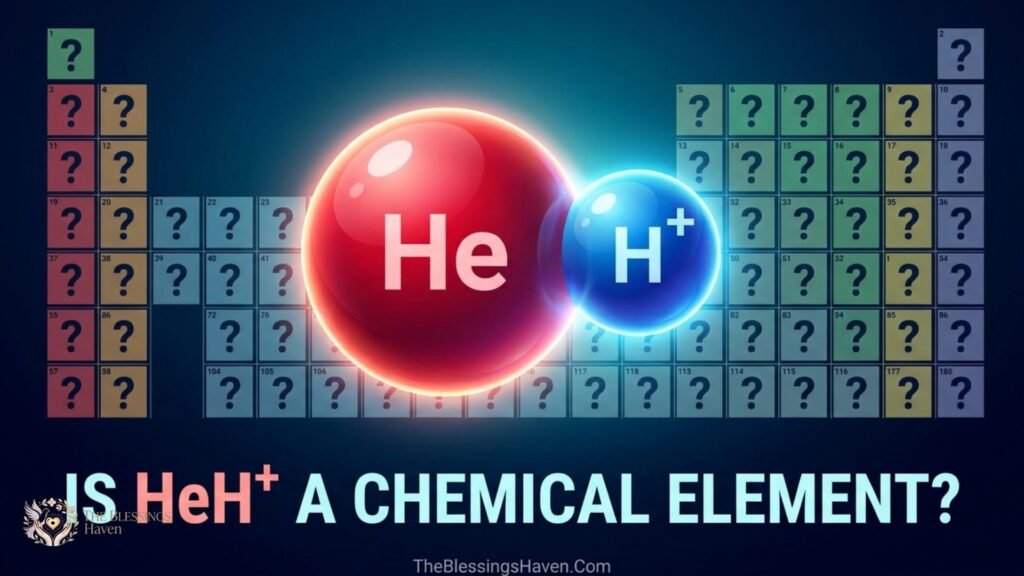
No.
A chemical element is defined by its atomic number, which represents the number of protons in the nucleus. Hydrogen is element 1, while helium is element 2.
HeH⁺ is different because it is a molecular ion. It contains a helium atom and a hydrogen component, and the entire species carries a positive charge. It therefore does not have an atomic number of its own and does not receive a separate position on the periodic table.
This distinction also helps explain why claims describing Helonium as a newly discovered element are incorrect. There is no officially recognized chemical element called Helonium.
ChEBI classifies HeH⁺ as a helium hydride and gives its systematic name as hydridohelium(1+).
What Is HeH⁺ Made Of?
HeH⁺ contains helium and hydrogen and has an overall charge of +1.
A simplified formation reaction is:
He + H⁺ → HeH⁺ + photon
In this reaction, neutral helium combines with a proton. Because the process releases energy as a photon, it is known as radiative association.
This reaction is especially important in models of primordial chemistry. During the cooling of the early Universe, neutral helium became available while free protons were still present. Under the appropriate conditions, these particles could form HeH⁺. The 2019 Nature study describes this process as the formation of the Universe’s first molecular bond in HeH⁺.
The resulting ion is extremely reactive, which is one reason it is more useful as a subject of spectroscopy and chemical modeling than as an ordinary bulk substance.
Why Is HeH⁺ Linked to the First Chemistry in the Universe?
The early Universe was initially too hot for stable molecular chemistry to develop. As the Universe expanded, it cooled, and charged particles gradually combined with electrons to form neutral atoms.
Helium recombined before hydrogen because helium has a higher ionization potential. This created a period in which neutral helium atoms could interact with protons that remained in the gas.
Under those conditions, HeH⁺ could form through radiative association.
This is why Helonium has such an important place in cosmic chemistry. The 2019 Nature paper explains that HeH⁺ is associated with the first molecular bond formed during the early Universe and that its subsequent destruction helped open a chemical pathway toward molecular hydrogen.
However, there is an important scientific distinction. Scientists did not directly observe the first HeH⁺ molecule forming shortly after the Big Bang. Its role in primordial chemistry comes from physical theory, laboratory measurements, astronomical observations, and chemical models.
Was HeH⁺ the First Molecule?
The most accurate wording is that HeH⁺ is considered the first molecular ion formed in the early Universe, and its formation is associated with the first molecular bond.
Scientific sources sometimes use the simpler phrase “first molecule,” but that can create confusion. HeH⁺ is electrically charged, whereas a neutral molecule such as H₂ has no net charge.
The distinction matters because the early Universe contained several stages of chemical evolution. HeH⁺ represents one of the earliest molecular species, and its reactions helped lead toward later hydrogen chemistry. Nature Astronomy described its 2019 detection as the discovery of the first molecular ion in the Universe.
So, when discussing Helonium, “first molecular ion” and “first molecular bond” are generally more precise descriptions than simply calling it the first molecule.
How Did HeH⁺ Help Lead to Molecular Hydrogen?
HeH⁺ can react with hydrogen atoms and participate in reactions that produce molecular hydrogen precursors.
One important reaction can be written as:
HeH⁺ + H → He + H₂⁺
The resulting H₂⁺ can take part in additional reactions that eventually contribute to the formation of neutral molecular hydrogen, H₂.
This matters because molecular hydrogen became an important coolant in the early Universe. Molecules can radiate energy through rotational and vibrational transitions, helping gas lose heat.
Cooling was a major part of the development of dense cosmic structures. As gas could cool and collapse, the conditions necessary for the formation of the earliest stars became increasingly possible.
For that reason, the chemistry of a tiny ion such as Helonium can be connected to much larger questions about how the first stars and structures developed.
When Was HeH⁺ First Found in a Laboratory?
The first laboratory evidence dates to 1925.
T. R. Hogness and E. G. Lunn published their work in Physical Review on July 1, 1925. Their experiments involved positive ions produced through electron impact and analyzed using mass-related measurements. The work became the historical laboratory foundation for identifying HeH⁺.
At that time, scientists had no way to observe the ion in interstellar space.
The astronomical confirmation would not come until 2019.
That means nearly a century passed between the early laboratory evidence and the first unambiguous astronomical detection.
The long delay was not because scientists forgot about HeH⁺. Instead, the challenge involved its weak astronomical signal, the difficult wavelength range of its most useful transition, and interference from other spectral features.
Why Was HeH⁺ So Hard to Find in Space?
One of the most important spectral transitions of HeH⁺ lies around 149.1 micrometres, corresponding to a frequency of roughly 2.01 THz.
Radiation at this wavelength is difficult to observe from the ground because Earth’s atmosphere strongly affects transmission in the far-infrared and terahertz regions.
Astronomers also had to distinguish the HeH⁺ signal from nearby spectral features produced by other molecules, particularly CH.
SOFIA provided a major advantage because it operated at high altitude above much of the atmospheric water vapour that interferes with far-infrared observations. Its GREAT receiver was capable of making the high-resolution terahertz measurements needed for the search.
The combination of improved laboratory frequencies, sensitive spectroscopy, and airborne observation finally made the detection possible.
Where Was HeH⁺ Found in Space?
Astronomers detected HeH⁺ in the planetary nebula NGC 7027.
Rolf Güsten and colleagues reported the result in Nature on April 17, 2019. The team used the GREAT spectrometer aboard SOFIA to detect the ground-state rotational transition of HeH⁺ at a wavelength of 149.1 micrometres.
The detection was important because it provided the first unambiguous evidence that HeH⁺ exists in interstellar space.
The observation also connected modern astronomical spectroscopy with laboratory chemistry first studied in the 1920s.
For decades, researchers had expected that environments such as planetary nebulae could contain enough HeH⁺ to become detectable. The 2019 observation confirmed that prediction.
Why Was NGC 7027 a Good Place to Look?
NGC 7027 is a young and chemically active planetary nebula containing hot ionized gas and abundant hydrogen and helium.
These conditions can support the chemical processes required for HeH⁺ production. The central star is extremely hot, creating an energetic environment in which ionization and recombination processes occur.
The location was therefore a useful natural laboratory for studying helium-hydrogen chemistry.
There is, however, an important distinction.
NGC 7027 is not primordial material left over unchanged from the Big Bang. It is a much younger planetary nebula. Scientists study HeH⁺ there because the chemical reactions occurring in that environment provide an astronomical test of chemistry that is also relevant to models of the early Universe.
The successful detection in NGC 7027 demonstrated that the ion could survive under suitable astrophysical conditions and that its spectral signature could be identified in space.
How Do Scientists Identify HeH⁺ in Space?
Scientists identify molecules by studying their spectral fingerprints.
Molecules can occupy specific rotational and vibrational energy levels. When they transition between those levels, they emit or absorb radiation at characteristic frequencies.
HeH⁺ has its own set of spectral transitions.
Astronomers can therefore search for a predicted line at a very specific wavelength or frequency. When the observed signal agrees with precise laboratory measurements and other possible sources are ruled out, scientists can identify the molecule with much greater confidence.
The 2019 detection relied on the ground-state rotational transition of HeH⁺ near 149.1 micrometres. Researchers were able to distinguish the target signal from nearby CH emission using the high-resolution capabilities of the GREAT instrument.
This is why laboratory spectroscopy is so important to astronomy. More accurate laboratory measurements provide better targets for searches with telescopes and observatories.
What Did Scientists Learn About HeH⁺ in 2025?
A 2025 study examined how HeH⁺ reacts with deuterium, a heavier isotope of hydrogen, at very low temperatures.
Researchers used a cryogenic storage-ring experiment to study reactions between HeH⁺ ions and neutral deuterium atoms. The work focused on collision energies and temperatures where older theoretical calculations had predicted a strong decrease in the reaction rate.
Instead, the measured reaction remained fast at low energies.
The study concluded that the reaction
HeH⁺ + D → HD⁺ + He
is effectively barrierless at low collision energies. The researchers also used updated theoretical calculations that better reproduced the experimental observations.
The result challenged assumptions used in some earlier chemical models.
Why Does the 2025 Result Matter?
Reaction rates are essential in astrochemistry because they influence how much of a particular chemical species can survive.
If HeH⁺ reacts more quickly than previously estimated at low temperatures, models of primordial chemistry may predict different abundances for HeH⁺ and molecules that form after it.
The 2025 Astronomy & Astrophysics study reported that the newly supported fast reaction suggests lower abundances of the first molecules at very high redshifts than some earlier calculations indicated. The authors also called for a reassessment of parts of helium chemistry used in early-Universe models.
This does not remove Helonium from the story of early molecular chemistry.
Instead, it shows that the details of that chemistry are still being refined.
Better reaction rates produce better models, and better models help scientists understand how the first molecular species may have evolved.
What Changed in 2026?
In 2026, researchers revisited the fundamental rotational transition of HHe⁺ using advanced action spectroscopy.
The study, published in Physical Chemistry Chemical Physics, used a 4 K, 22-pole ion trap together with a powerful terahertz source. Several action-spectroscopy methods were applied to measure the J = 1 ← 0 rotational transition with greater precision.
The refined frequency was reported as:
2010.183312(8) GHz
The authors stated that the new result improved the accuracy and precision of the earlier transition measurement by about one order of magnitude. The paper was first published on January 27, 2026.
This may appear to be a small numerical improvement, but it matters greatly for astronomy.
A more precise laboratory frequency gives astronomers a more exact target when searching for Helonium in astronomical spectra.
Is HeH⁺ a Strong Acid?
In gas-phase ion chemistry, HeH⁺ is an exceptionally strong proton donor.
That description needs context.
HeH⁺ can transfer its proton readily to other species because helium has an extremely low proton affinity. As a result, the ion is highly reactive when it encounters suitable molecules or atoms.
However, this should not be confused with an ordinary liquid acid.
You cannot treat Helonium as a bottleable acid comparable to sulfuric acid or hydrochloric acid. Its relevance to acidity comes from gas-phase ion chemistry and proton-transfer behavior.
This extreme reactivity is one reason HeH⁺ is difficult to isolate as a conventional bulk substance. It is mainly studied under controlled laboratory and astrophysical conditions.
You May Like to Read: Pressvibepulse Com 2026: Powerful Benefits, Risks & Key Insights
Can Scientists Make HeH⁺ on Earth?
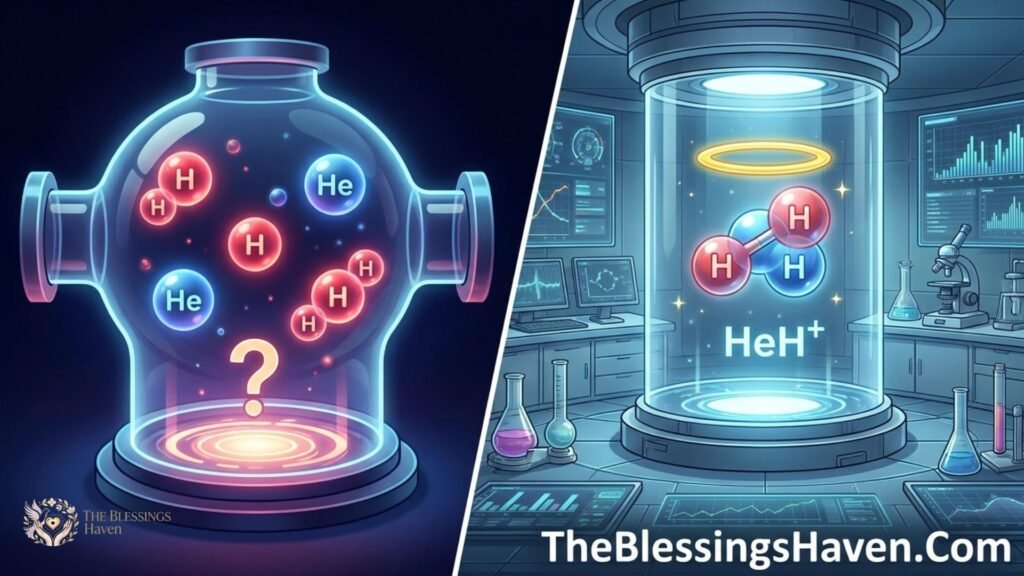
Yes.
Scientists have produced and studied HeH⁺ in laboratories since the early twentieth century.
Modern experiments can generate HeH⁺ ions and investigate them using mass spectrometry, ion traps, cryogenic storage rings, and high-resolution spectroscopy. The 2026 study, for example, created HHe⁺ ions and confined them in a cryogenic ion-trap apparatus for precision spectroscopic measurements.
This is an important point because Helonium is not a hypothetical chemical species created only by computer models.
It has been produced experimentally, measured repeatedly, and observed in space.
At the same time, its extreme reactivity means that it is not handled like a conventional chemical that can simply be produced and stored in a bottle for everyday use.
Does HeH⁺ Have Everyday Uses?
Helonium has no established everyday consumer use.
Its importance is primarily scientific. Researchers study it because its unusual chemistry provides information about molecular formation, ion reactions, spectroscopy, and the chemical conditions of astrophysical environments.
Major areas of research include:
- early-Universe chemistry;
- astrochemical reaction networks;
- molecular spectroscopy;
- ion-molecule reactions;
- low-temperature chemical processes;
- theoretical molecular calculations;
- astronomical spectral searches.
Its greatest value comes from what scientists can learn from it.
HeH⁺ is one of the simplest molecular ions, making it an especially useful system for testing detailed chemical and physical theories.
Helium vs HeH⁺
| Feature | Helium | HeH⁺ |
|---|---|---|
| Type | Chemical element | Molecular ion |
| Symbol/formula | He | HeH⁺ |
| Atomic number | 2 | None |
| Net charge in form shown | 0 | +1 |
| Contains hydrogen | No | Yes |
| Periodic-table entry | Yes | No |
| Chemical classification | Noble-gas atom | Helium hydride ion |
| Main context here | Atomic helium | Astrochemistry and spectroscopy |
The difference is straightforward: helium is an element, while HeH⁺ is a charged molecular species made from helium and hydrogen. ChEBI classifies HHe as hydridohelium(1+) and records its net charge as +1.
Key Timeline
1925: T. R. Hogness and E. G. Lunn publish the laboratory work that provided evidence for HeH⁺.
Late 1970s: Researchers increasingly examined whether HeH⁺ could exist in astrophysical environments, including planetary nebulae.
2019: Astronomers using SOFIA and the GREAT/upGREAT instrument detect HeH⁺ in the planetary nebula NGC 7027. The result is published in Nature on April 17, 2019.
2025: A cryogenic experiment finds that the HeH⁺ + D reaction remains fast at low collision energies, supporting a barrierless reaction model.
2026: Precision spectroscopy refines the fundamental rotational transition of HHe⁺ to 2010.183312(8) GHz.
Common Claims Checked
| Claim | Answer |
|---|---|
| Helonium is a chemical element | False |
| Helonium has atomic number 119 | False |
| Helonium refers to HeH⁺ | True |
| It contains helium and hydrogen | True |
| Its net charge is +1 | True |
| Laboratory evidence dates to 1925 | True |
| Secure space detection came in 2019 | True |
| NGC 7027 was the detection target | True |
| SOFIA was used for the detection | True |
| It is connected with early-Universe chemistry | True |
| Its reactions were still being studied in 2025 | True |
| Its spectral frequency was refined in 2026 | True |
The chemical identity is documented by ChEBI, the historical laboratory work by Physical Review, the astronomical detection by Nature, and the later reaction and spectroscopy studies by Astronomy & Astrophysics and Physical Chemistry Chemical Physics.
Why Does This Ion Still Matter?
Helonium is incredibly small, but the scientific questions connected to it are enormous.
Its chemistry helps researchers investigate how molecular species could have formed when the Universe was young. Its reactions provide tests for astrochemical models, while its spectral transitions give astronomers a precise way to search for the ion in space.
The 2019 detection showed that HeH⁺ is actually present in an astrophysical environment. The 2025 reaction experiment demonstrated that some low-temperature chemical assumptions needed revision. The 2026 spectroscopy study then provided a more precise frequency for the ion’s fundamental rotational transition.
Together, these studies show that Helonium is not simply an interesting historical molecule.
It remains an active research subject.
Scientists can use this simple ion to connect laboratory chemistry with observations of distant astronomical objects and models of the earliest stages of cosmic chemical evolution.
Final Thought
Helonium is not a mystery element or a hidden entry on the periodic table.
It is the helium hydride ion, HeH⁺, a positively charged molecular species made from helium and hydrogen. Its laboratory history goes back to 1925, while its first unambiguous detection in interstellar space came in 2019 when astronomers observed it in NGC 7027 with SOFIA.
What makes Helonium remarkable is its connection to the beginning of molecular chemistry.
Early-Universe models place HeH⁺ among the earliest molecular species to form, with its formation representing the first molecular bond in that chemical history. Later reactions helped connect this simple ion to molecular hydrogen and the broader development of cosmic chemistry.
Research has not stopped there. Experiments in 2025 continued refining its reaction chemistry, while work published in 2026 improved the precision of its fundamental rotational frequency.
A tiny molecular ion can therefore tell scientists something much bigger: how simple chemistry may have begun to develop in the early Universe.
FAQ
What is a helonium?
Helonium is another name for the helium hydride ion, HeH⁺, a positively charged molecular ion made of helium and hydrogen.
Is helonium a word?
Yes. Helonium is a recognized name for the helium hydride ion, although it is not the name of a chemical element.
What is a helium ion called?
A helium ion can be called a helium cation or helium ion. HeH⁺ specifically is called the helium hydride ion.
Is helium hydride the strongest acid?
In gas-phase chemistry, HeH⁺ is considered an exceptionally strong proton donor, but it is not treated as the strongest acid in ordinary liquid chemistry.

I’m the creator of The Blessings Haven, sharing heartfelt blessings, inspiring quotes, and meaningful wishes to brighten your day and spread positivity.