


The Fintechzoom.io Stock Market Course is an online financial education offering associated with the FintechZoom.io website. Its course pages describe learning opportunities focused on stock market trading, investment strategies, market analysis, and financial decision-making.
Learning how the stock market works can feel overwhelming when you are just starting. Terms such as technical analysis, portfolio diversification, market volatility, and fundamental analysis may seem complicated without a clear learning path. That is why many beginners explore online stock market courses before making their first investment or trade.
But is the course suitable for beginners? What topics does it cover, how are the lessons delivered, and is it worth considering?
One important point: a stock market course can help you build knowledge, but it cannot guarantee investment profits. Real-world results depend on market conditions, individual decisions, experience, and risk management.
What Is Fintechzoom.io?
FintechZoom.io is a website that publishes financial information and offers educational resources related to personal finance, trading, and investing. Its course section lists several learning options, including financial literacy, stock market trading, and stock market investing.
The website’s educational approach is intended to help learners understand financial concepts and develop practical knowledge. Its advertised resources include self-paced learning, video lessons, quizzes, and supporting materials, although the exact features vary by course.
It is useful to distinguish between the website’s financial information and its educational programs. Reading a market-news article is different from following a structured course designed to teach trading or investing skills.
Financial news can help readers follow economic developments, company announcements, and market movements. A course, meanwhile, aims to organize concepts into lessons that learners can study progressively.
Anyone researching Fintechzoom.io should review the specific course page rather than assuming that every service or feature is included in every program. Check the curriculum, instructor information, duration, price, access conditions, and refund policy before making a purchase.
What Is the Fintechzoom.io Stock Market Course?

The Fintechzoom.io Stock Market Course generally refers to the site’s stock-market education offerings. Its official course pages distinguish between a Stock Market Trading program and a Stock Market Investing program.
Although these subjects overlap, they have different objectives.
A trading course typically focuses on analyzing price movements, understanding market trends, identifying trading opportunities, and managing risk when entering and exiting positions.
An investing course generally emphasizes evaluating assets, understanding risk and return, building a diversified portfolio, and working toward longer-term financial goals.
The official FintechZoom.io pages advertise learning material for beginners and people with some existing financial knowledge. The trading course describes video lessons, practical resources, quizzes, and a certificate of completion. The investing course advertises on-demand videos, worksheets, interactive quizzes, and a completion certificate.
These are advertised course features, not independent evidence that every learner will achieve a particular level of competence.
Before enrolling, review the actual syllabus to determine whether the lessons match your experience level. You should also check whether the course includes practical exercises, clear explanations, current examples, and opportunities to review your understanding.
The most useful course is not necessarily the one with the boldest promises. It is the one that teaches relevant concepts clearly and helps you understand both opportunities and risks.
What Does the Course Teach?
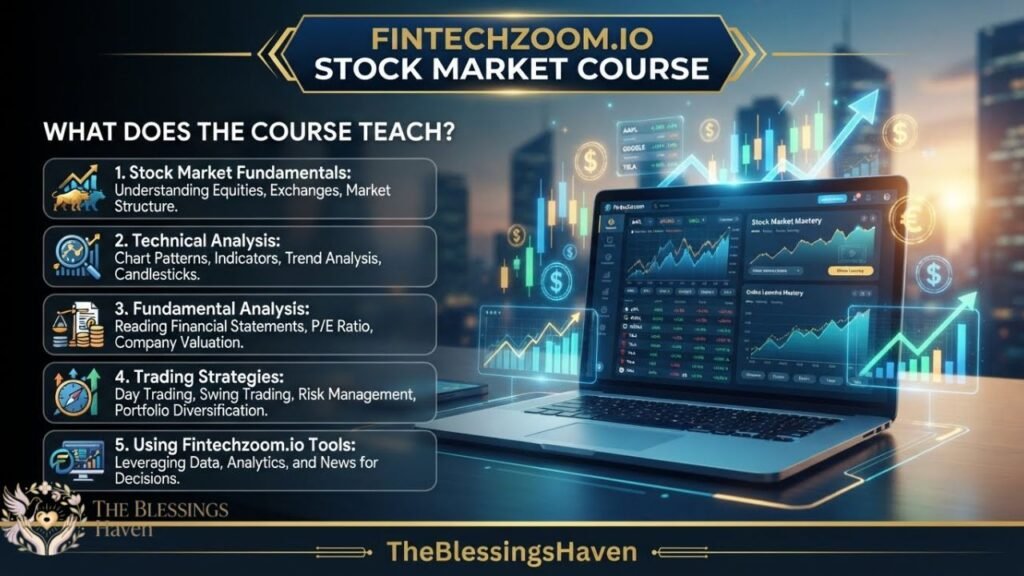
The course topics depend on whether you select the trading or investing program. The following areas are important parts of stock market education and are relevant to evaluating the advertised learning objectives.
Stock Market Basics
Understanding the stock market is an essential starting point for new learners.
A stock represents ownership in a company. When investors buy shares, they gain an interest in that business, although the rights attached to shares depend on the type of security and its terms.
Stock exchanges provide organized markets where eligible securities can be bought and sold. Prices move in response to factors such as company performance, economic developments, investor expectations, and supply and demand.
Beginners should also understand the difference between stocks, bonds, exchange-traded funds (ETFs), and mutual funds. These financial instruments have different characteristics, costs, and risk profiles.
Another foundational concept is the distinction between trading and investing. Trading generally involves seeking opportunities over shorter periods, while long-term investing focuses more on asset growth and financial objectives over time.
A useful stock market course should explain these ideas in plain language before introducing more advanced strategies. Learners should understand market orders, limit orders, bid and ask prices, and basic market terminology.
This foundation makes it easier to understand later lessons on chart reading, company analysis, and portfolio management.
Technical Analysis and Chart Reading
Technical analysis involves studying market prices, trading volume, and chart patterns to assess potential market behavior.
A stock market trading course may introduce candlestick charts, trend identification, support and resistance levels, and common technical indicators. These tools help traders organize information about historical price movements.
For example, a candlestick chart displays information about a security’s opening, closing, high, and low prices during a selected period. Traders may use these charts to examine price momentum or identify patterns they want to investigate further.
Support and resistance refer to price areas where buying or selling pressure has historically appeared. However, these levels are not guaranteed to hold, and prices can move through them unexpectedly.
Technical indicators can help summarize market data, but they should not be treated as prediction machines. Different indicators may produce conflicting signals, and historical patterns do not guarantee future outcomes.
When evaluating the Fintechzoom.io trading course, check whether it explains the limitations of technical analysis alongside its tools. Practical examples and exercises can help learners understand how chart patterns work without assuming that every pattern creates a profitable trade.
Fundamental Analysis
Fundamental analysis focuses on a company’s financial condition, business model, competitive position, and prospects.
Investors may review financial statements, earnings reports, revenue, expenses, debt, cash flow, and other indicators to assess a business. They may also consider the broader industry and economic environment.
Three important financial statements are:
- Income statement: Shows a company’s revenue, expenses, and profit or loss over a reporting period.
- Balance sheet: Summarizes assets, liabilities, and shareholders’ equity at a particular date.
- Cash flow statement: Explains how cash moves into and out of a business through operating, investing, and financing activities.
The price-to-earnings ratio, commonly called the P/E ratio, is another measure used in company analysis. It compares a company’s share price with its earnings per share, although its usefulness depends on the business, industry, and reliability of the earnings figure.
A company with strong financial results is not automatically a good investment at every price. Investors must also consider valuation, future expectations, uncertainty, and potential downside.
The official FintechZoom.io investing course describes topics such as evaluating stocks and other assets, assessing risk and reward, and interpreting economic indicators. Prospective learners should check the detailed syllabus to determine how thoroughly fundamental analysis is covered.
Risk Management and Capital Protection
Risk management is one of the most important skills in trading and investing.
Financial markets are uncertain, and even well-researched decisions can result in losses. Risk management helps individuals recognize those possibilities and decide how much exposure they can reasonably accept.
For traders, risk-management methods may include setting position sizes, defining exit conditions, using stop-loss orders where appropriate, and avoiding excessive leverage. A stop-loss order can help manage a position, but execution prices may differ from the intended level during fast-moving markets or price gaps.
Investors may manage risk by diversifying their holdings, reviewing asset allocation, maintaining appropriate cash reserves, and matching investment choices to their time horizon and financial circumstances.
Risk tolerance is another important concept. A strategy that feels manageable to one person may be unsuitable for someone who cannot afford substantial losses.
A responsible stock market course should explain that risk cannot be eliminated entirely. It should help learners recognize uncertainty rather than promise a reliable method for making money.
When reviewing the Fintechzoom.io course, look for clear lessons on capital protection, trading discipline, market volatility, and the dangers of emotional decision-making.
Portfolio Building and Diversification

Portfolio building involves selecting and managing a collection of investments in line with a person’s goals, time horizon, and risk tolerance.
A portfolio may include stocks, bonds, ETFs, cash, and other assets, depending on the investor’s circumstances and strategy.
Diversification means spreading investments across different assets, companies, industries, or markets instead of relying heavily on one holding. It can reduce the impact of certain company-specific risks, although it cannot prevent losses across an entire market during a downturn.
Asset allocation is the process of deciding how much of a portfolio to place in different categories. The appropriate mix depends on factors such as financial goals, investment horizon, income needs, and willingness to accept risk.
Portfolio management may also involve reviewing performance and rebalancing when holdings move away from a chosen allocation.
The FintechZoom.io investing course advertises topics that include asset allocation, diversification, investment strategies, and portfolio optimization. These subjects may be useful to learners who want to understand long-term investing rather than focus exclusively on short-term trades.
Before enrolling, check whether the course explains portfolio decisions through practical examples and discusses the limitations of different strategies. A sound learning program should encourage informed decisions rather than suggest that one portfolio suits everyone.
Market News and Economic Trends
Stock prices can be influenced by company earnings, interest-rate decisions, inflation, employment figures, geopolitical developments, and changes in investor expectations.
Understanding market news can help learners interpret why prices move and how broader economic conditions affect businesses and financial assets.
For example, higher interest rates may increase borrowing costs for companies and consumers. They can also affect bond yields and the relative attractiveness of different investments. However, the effect on any particular stock depends on many factors, including the company’s financial position and what investors already expect.
Economic indicators provide information about the state of the economy. Examples include inflation measures, employment reports, consumer spending, and gross domestic product.
Market news should be interpreted carefully. A headline may describe an event without explaining how it affects a company’s future earnings or valuation. Prices may also move in unexpected directions when news differs from market expectations only slightly.
The FintechZoom.io trading and investing pages describe learning about market trends, economic indicators, and the role of news and global events. Review the syllabus to confirm the depth of these lessons and whether the examples are current.
Learning to assess news critically is more valuable than simply reacting to every headline.
How Are the Lessons Delivered?

FintechZoom.io advertises a self-paced learning format for its courses. According to the official course pages, the trading program includes approximately four to six hours of on-demand video lessons, while the investing program lists approximately seven to eight hours.
The advertised materials also include quizzes and supporting resources. The trading course describes downloadable charts and strategy guides, while the investing course lists printable worksheets and interactive quizzes. Both pages advertise a certificate of completion.
These features can be useful for learners who prefer studying around work, school, or other responsibilities. Self-paced learning allows students to pause lessons, revisit explanations, and review difficult concepts.
Quizzes can also help learners identify topics they have not fully understood. However, completing a quiz or receiving a certificate does not necessarily demonstrate professional trading ability.
Before purchasing, verify the current course duration, access period, certificate conditions, support options, and exact materials included. The general courses page also advertises lifetime access and a 30-day satisfaction guarantee, but you should confirm that the relevant terms apply to the specific course you intend to buy.
A course’s value depends not only on its format but also on the clarity of its teaching, the quality of its examples, and how well it matches your learning goals.
Who Is the Course Best For?
The Fintechzoom.io Stock Market Course may be worth investigating for several types of learners.
- Complete beginners: People new to financial markets may benefit from structured explanations of stocks, exchanges, market terminology, and investment principles. Beginners should prioritize foundational knowledge before attempting complex strategies.
- Aspiring traders: Learners interested in shorter-term market activity may want to explore lessons about price charts, technical analysis, trading methods, and risk management. Trading involves substantial risk and requires practice beyond simply watching lessons.
- Long-term investors: People planning to build wealth over time may be more interested in fundamental analysis, asset allocation, diversification, and investment planning.
- Working professionals: A self-paced format may appeal to people who need flexibility around their existing schedules. Check the actual workload and access terms before enrolling.
- Learners improving their financial literacy: People who want to understand market news and financial terminology may find an introductory course useful, even if they do not intend to trade actively.
The course may be less suitable for someone expecting guaranteed returns, personalized financial advice, or an immediate route to professional trading success.
Choosing the right course begins with identifying your goal. Learning to understand the market, managing a long-term portfolio, and executing short-term trades are different objectives that require different skills.
Fintechzoom.io Trading Course vs. Investing Course
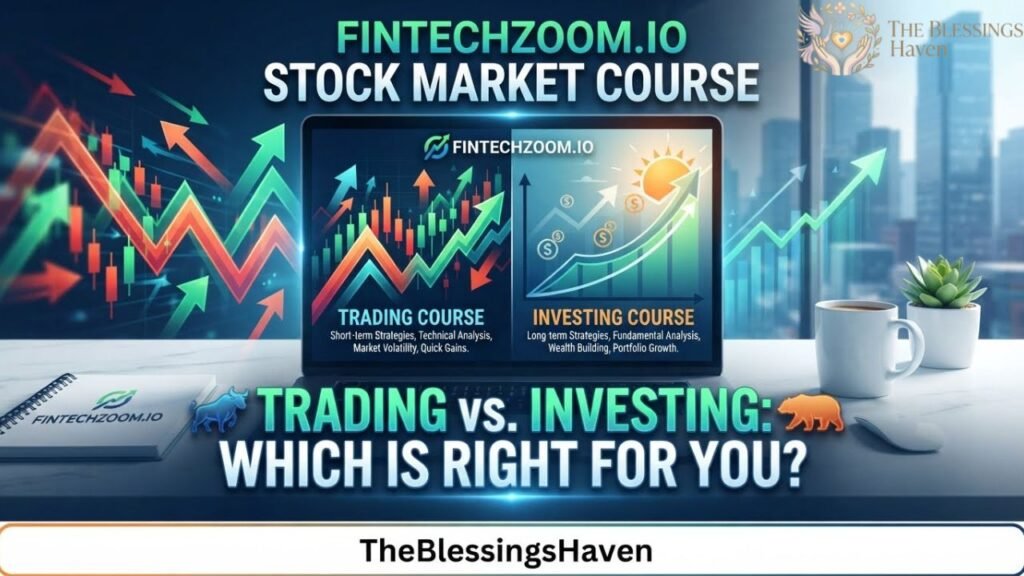
FintechZoom.io lists separate programs for stock market trading and stock market investing. Understanding their differences can help you choose the more relevant option.
| Feature | Trading course | Investing course |
|---|---|---|
| Main objective | Understand trading methods and market activity | Learn investment principles and portfolio management |
| Typical focus | Price movements, chart patterns, trading strategies, and risk controls | Asset classes, valuation, diversification, and long-term goals |
| Time horizon | Often shorter, depending on the trading style | Often longer, depending on the investor’s goals |
| Useful skills | Technical analysis, execution discipline, and risk management | Fundamental analysis, asset allocation, and portfolio review |
| Main risk consideration | Frequent decisions, volatility, and possible trading losses | Market downturns, valuation risk, and long-term uncertainty |
| Best starting point | Learners specifically interested in active trading | Learners focused on building and managing investments |
The trading course page advertises video lessons, practical resources, quizzes, and a completion certificate. The investing course page advertises on-demand videos, worksheets, quizzes, and a certificate.
These are advertised features, and the full syllabus should be reviewed before choosing either program.
If you want to understand short-term price movements and trading techniques, the trading course may align more closely with your goals. If your main objective is evaluating assets and building a diversified portfolio, the investing course may be a better match.
Neither option guarantees success in financial markets. The right choice depends on your objectives, experience, time commitment, and willingness to accept risk.
What Should You Check Before Enrolling?
Before paying for the Fintechzoom.io Stock Market Course, review the following details carefully.
Course curriculum
Read the full syllabus and confirm which topics are actually included. Look for clear learning objectives rather than broad claims about mastering the stock market.
Instructor credentials
Check whether instructors are identified and whether their education, professional background, or relevant experience can be verified independently.
Total cost
Confirm the current price, currency, payment schedule, taxes, and any additional costs. Do not assume a price shown in an older review remains accurate.
Refund policy
Read the refund terms carefully, including eligibility conditions, deadlines, exclusions, and the process for requesting a refund. A general website guarantee may not automatically apply to every product.
Lesson duration and access
Check the advertised course length, whether content is available on demand, and how long you can access the materials.
Practical exercises
Find out whether the course provides useful examples, chart exercises, worksheets, quizzes, or other activities that help reinforce concepts.
Certificate details
Determine what the certificate represents and whether it is simply a certificate of completion. Do not assume it is an accredited professional qualification unless that status can be independently verified.
Independent reviews
Look for detailed feedback from credible sources. Be cautious about testimonials that make extraordinary profit claims or do not explain the reviewer’s actual experience.
Risk disclosures
A responsible course should make it clear that trading and investing involve risk and that educational content is not a guarantee of financial results.
Suitability for your goals
Choose the program that fits your needs. An investing course may be more appropriate for long-term financial planning, while a trading course may be more relevant to people studying active trading methods.
Taking time to check these details can help you avoid paying for a course that does not match your expectations.
Is the Fintechzoom.io Stock Market Course Worth It?
Whether the Fintechzoom.io Stock Market Course is worth it depends on the quality of the lessons, the current price, the support provided, and your personal learning objectives.
The advertised structure offers several potentially useful elements: self-paced videos, quizzes, supporting resources, and separate learning paths for trading and investing. These features may help learners organize their studies rather than relying entirely on scattered articles and videos.
However, advertised features alone are not enough to establish overall value. The course’s suitability depends on the depth of its explanations, the relevance of its examples, the credibility of its instructors, and whether the material offers meaningful learning beyond freely available resources.
For a beginner, a structured course may be helpful if it explains fundamental concepts clearly and emphasizes risk management. Someone with more experience should compare the syllabus against their existing knowledge to avoid paying for material they already understand.
The course is less likely to meet expectations if you want guaranteed profits, personalized portfolio recommendations, or a shortcut to becoming a successful trader.
Before enrolling, compare the official course details with other educational options and decide whether the price is reasonable for the content offered.
Verdict: Fintechzoom.io’s trading and investing courses may be worth considering as educational resources, but their value should be judged by the verified syllabus, instructor credentials, current terms, and learning outcomes—not by promises of financial success.
Advantages and Limitations
Understanding both the potential benefits and the limitations can help you make a more balanced decision.
Advantages
- Structured learning: A course can organize financial concepts into a more manageable learning sequence.
- Flexible study: Advertised on-demand lessons may suit learners with busy schedules.
- Interactive practice: Quizzes and worksheets can help reinforce key ideas.
- Different learning paths: Separate trading and investing programs allow learners to focus on different objectives.
- Practical subject matter: Topics such as chart reading, risk management, and diversification are relevant to financial education.
- Review opportunities: Self-paced materials can make it easier to revisit difficult concepts.
Limitations
- No guaranteed profits: Education cannot remove market uncertainty or guarantee positive returns.
- Course quality needs verification: Advertised features do not independently prove that the instruction is comprehensive or effective.
- Potentially limited depth: The advertised lesson duration may not be sufficient for mastering complex financial skills.
- Credentials need checking: Verify instructor backgrounds and the meaning of any certificate.
- Additional practice is necessary: Watching lessons alone does not establish trading or investing competence.
- Terms may change: Pricing, refund eligibility, access periods, and course content should be checked before purchase.
Overall, the potential benefits are most relevant to learners who want structured financial education and are prepared to continue learning independently. The limitations matter most to people expecting immediate results or professional-level expertise from a short course.
Frequently Asked Questions
What is the Fintechzoom.io Stock Market Course?
It is an online financial education offering associated with FintechZoom.io, which lists separate courses focused on stock market trading and investing.
Is the Fintechzoom.io course suitable for beginners?
The official course pages state that beginners can enroll. Review the syllabus first to ensure the lessons start at a level you can follow.
What topics does the course cover?
The advertised subjects include trading methods, stock analysis, investment principles, market trends, and risk management. The precise topics vary between the trading and investing programs.
Does the course teach technical and fundamental analysis?
The trading program emphasizes chart patterns and price movements, while the investing program describes asset evaluation and market analysis. Check the detailed syllabus for the exact coverage of each method.
Does Fintechzoom.io guarantee stock market profits?
No course should be treated as a guarantee of profits. Stock market trading and investing involve risk, and losses are possible even when learners apply what they have studied.
What is the difference between the trading and investing courses?
The trading course focuses on market activity and trading techniques, while the investing course emphasizes asset selection, diversification, and longer-term financial goals.
What should you check before enrolling?
Verify the syllabus, instructor credentials, total cost, refund terms, access period, certificate details, and independent reviews before making a payment.
Is the Fintechzoom.io Stock Market Course worth it?
It may be useful if its verified lessons match your goals and provide good value for the price. Compare the course details with alternatives and do not expect guaranteed financial returns.
Conclusion
The Fintechzoom.io Stock Market Course is an online financial education option with separate advertised paths for trading and investing. Its course pages describe self-paced video lessons, practical learning materials, quizzes, and certificates of completion.
The trading program is aimed at learners interested in market activity, chart analysis, trading techniques, and risk controls. The investing program focuses more broadly on investment principles, asset allocation, diversification, and long-term financial goals.
These distinctions can help prospective students identify the course that best matches their objectives. Nevertheless, the value of either program depends on its current curriculum, teaching quality, instructor credentials, price, and applicable terms.
Before enrolling, verify the details directly on the official course page and avoid relying on unsupported testimonials or promises of profits. Remember that financial education is only one part of responsible market participation; continued practice, careful research, and realistic risk management remain essential.
#Fintechzoom.io Stock Market Course

Welcome to The Blessings Haven! Rathna is a passionate content creator sharing heartfelt blessings, inspirational quotes, prayers, and meaningful wishes, along with helpful technology articles, digital trends, and online guides.


Pingback: Growth Navigate Startup Tools and Funding Guide 2026